



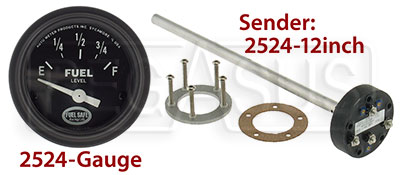
Note: This information applies to the original (pre-2010) Pegasus Part No. 2524-12 inch and 2524-24 inch senders only. These senders can be identified by the adjustment screws on the top plate.
A. Sensor Preparation
- Measure the depth of your fuel cell from the outside top to the inside bottom.
- Using a tubing cutter, cut the outside tube approximately ¼” shorter than the measured depth. Be careful not to damage the center tube.
- Plastic insulators are installed between the inner and outer tubes to prevent them touching. Slide any exposed insulators on the center tube up until they are just inside the outer tube.
- Cut off the center tube approximately flush with the outside tube. Be sure the two tubes are not touching. The meter will stay pegged above the full mark when the ignition is turned on if they touch.
B. Sensor Calibration
Sensor calibration is required if you have cut your sending unit. If you leave your sender at full length, only a minor adjustment of the “Full” level should be needed. The “Empty” and “Full” screws are located on top of the sender. A small flat-blade screwdriver is required for adjustment.
- Ensure the unit is dry before you attempt calibration. Any residual liquid inside the tube will give a false reading and may affect calibration. If the sender has been immersed in liquid, let it dry thoroughly before proceeding. This may take a few hours.
- Disconnect the battery and connect the sending unit as shown in the wiring diagram, but do not install it in the fuel cell. Turn on the ignition and wait five minutes for the meter to warm up. Turn both the “Full” and “Empty” screws to the full CW (clockwise) direction.
- Slowly turn the “Empty” screw CCW (counter-clockwise) until the needle on the gauge just stops moving downward. The needle should have stopped on or just below the Empty mark. If you turn the screw CW from this point, the needle should begin to move immediately. Turn the screw CCW until it just stops moving down again. This is the Empty reference mark. Repeat this step until you are sure that you have the correct mark.
- Insert the probe into the fuel cell. Turn the “Full” screw CCW until the needle indicates the correct fuel level. This step will be easier if the cell is completely full and you aim for the Full mark on the gauge.
- Remove the probe from the fuel cell. The needle on the gauge should move down the scale as you pull the tube out of the fuel.
- This completes the calibration of the fuel level sender. Do not make any more adjustments to the “Full” or “Empty” screws.
C. Alarm Calibration
- Lift the probe out of the cell and shake it gently to remove residual liquid from inside the tube.
- Lower the tube into the cell slowly until the gauge registers the desired alarm trip point. With the tube held at that level, turn the “Alarm Adjust” screw until the alarm turns on.
- Move the probe up and down in the fuel to verify proper calibration.
- Install the sending unit in the fuel cell. Calibration is now complete.